Complete Guide to GST Calculation
GST Exclusive Calculation
GST Exclusive means the price of the product does not include the tax amount. You need to add the GST on top of the base price.
GST Amount = (Original Cost × GST %) / 100
Net Price = Original Cost + GST Amount
Example: If base price is ₹1,000 and GST is 18%, then GST = ₹180, Total = ₹1,180.
GST Inclusive Calculation
GST Inclusive means the tax is already part of the total price. This tool helps you "back-calculate" to find the original price.
GST Amount = Total - (Total / (1 + (GST % / 100)))
Original Cost = Total - GST Amount
Example: If total price is ₹1,180 and GST is 18%, then GST = ₹180, Base Price = ₹1,000.
Understanding the Components of GST
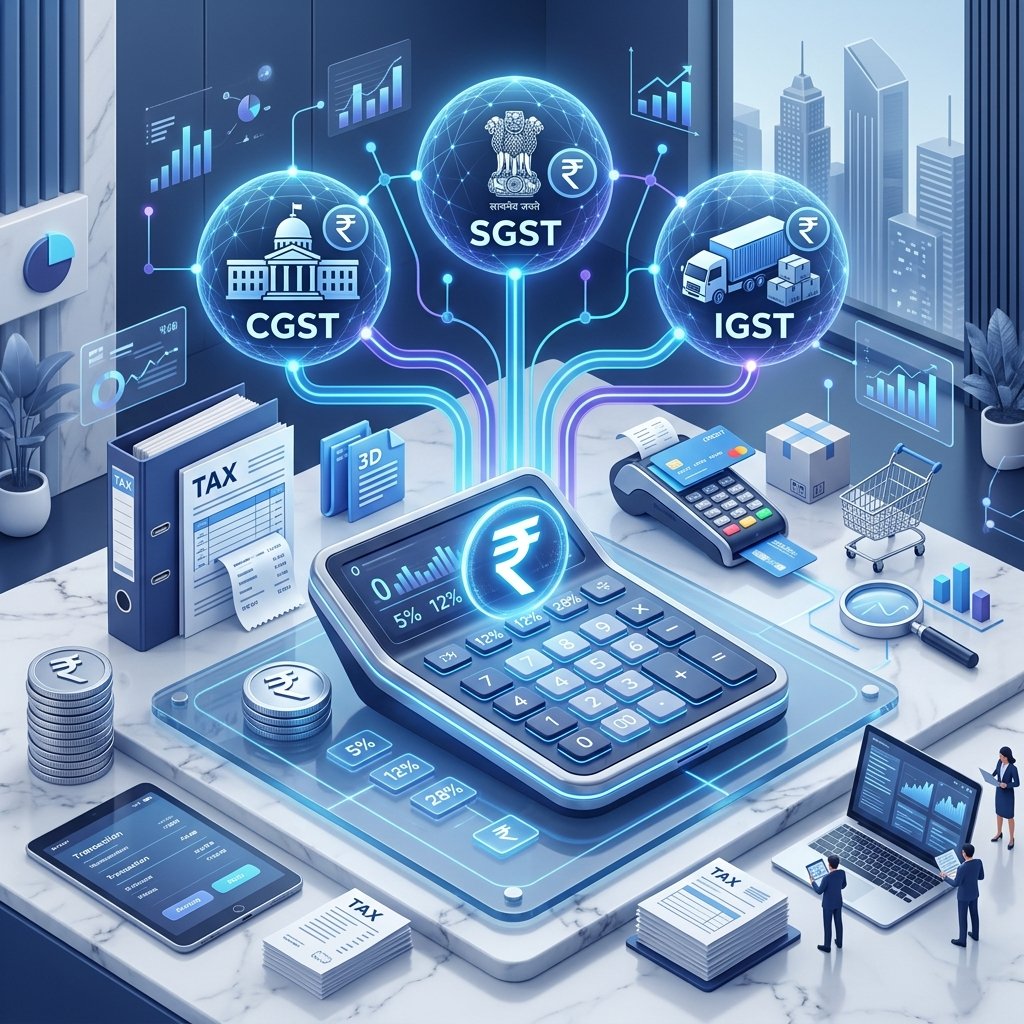
Tax is collected by both Central and State governments depending on whether the transaction is intra-state or inter-state:
| Component | Full Form | Collected By | Applicability |
|---|---|---|---|
| CGST | Central GST | Central Govt | Intra-state (Within same state) |
| SGST | State GST | State Govt | Intra-state (Within same state) |
| IGST | Integrated GST | Central Govt | Inter-state (Between two states) |
| UTGST | Union Territory GST | UT Govt | Within Union Territories |
Current GST Tax Slabs in India (2025-26)
The Indian government has categorized over 1300 goods and 500 services into four main tax slabs. Here is an overview of GST rates 2025-26:
GST Registration: Who Needs to Register?
Not every business is required to register under GST. The government has set specific turnover thresholds for registration eligibility:
Goods Suppliers
Registration is mandatory if the annual turnover exceeds ₹40 Lakhs (₹20 Lakhs for special category states).
Service Providers
Registration is mandatory if the annual turnover exceeds ₹20 Lakhs (₹10 Lakhs for special category states).
Inter-state Sales
Any business making inter-state supply of goods must register regardless of turnover.
A Journey of a Product: How GST is Levied?
GST is a multi-stage tax. Let's look at how it works in a simplified chain:
1. Manufacturer: Buys raw materials and adds value. Pays GST on purchase and collects GST on sale. (Claims Input Tax Credit).
2. Wholesaler: Buys from the manufacturer. Adds his margin. Pays GST and gets credit for the tax paid by the manufacturer.
3. Retailer: Final stage before the product reaches the consumer. Adds local costs and profit margins. Collects GST from the consumer.
4. End Consumer: Bears the full tax burden of all stages. No Input Tax Credit available for the consumer.
Key GST Return Forms Every Business Should Know
To stay compliant, businesses must file internal reports called GST Returns. Here are the most common ones:
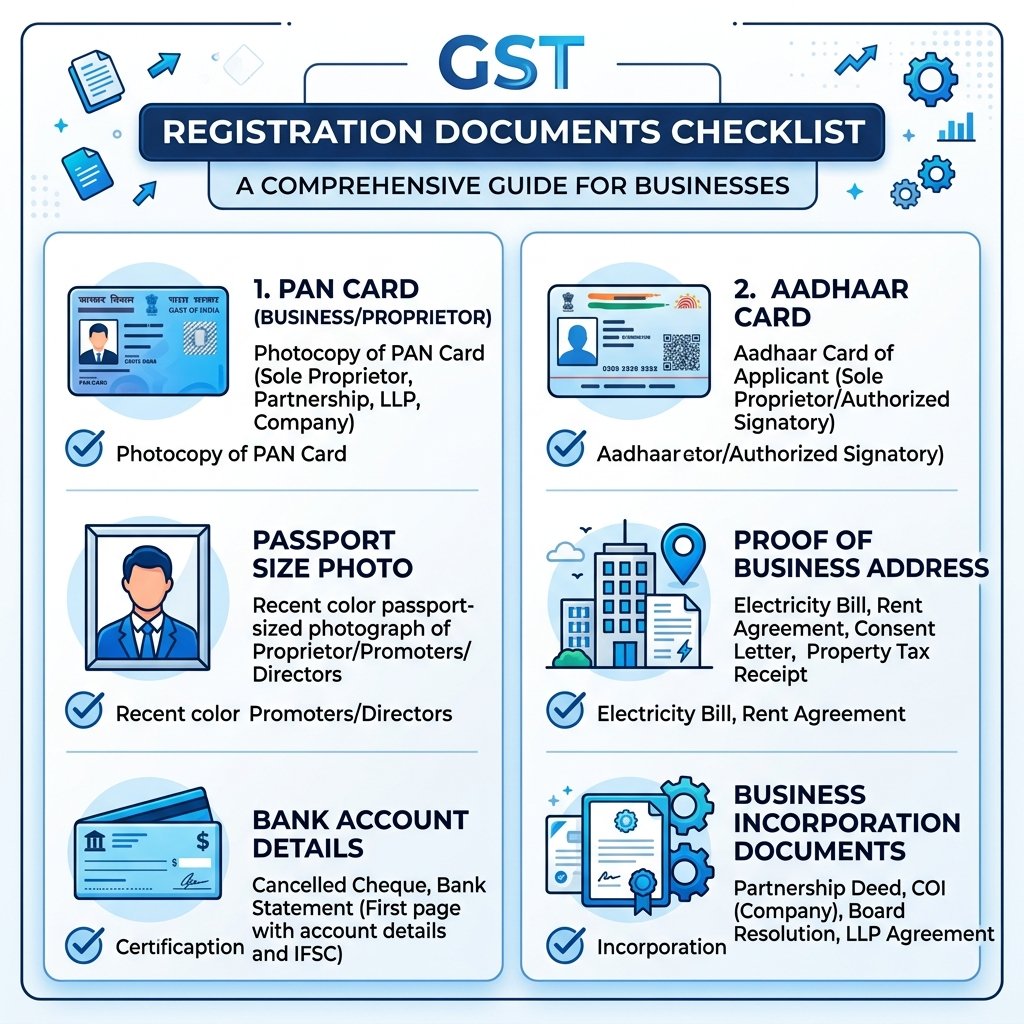
Documents Required for GST Registration (Full Checklist)
For Individuals & Sole Proprietorship
- PAN Card: Original PAN card of the owner.
- Aadhaar Card: For identity and biometric verification.
- Address Proof: Electricity bill, rent agreement, or property tax receipt.
For Partnership Firms & LLP
- Partnership Deed: Legally signed deed of the firm.
- Partners' Details: PAN and Aadhaar of all active partners.
- No Objection Certificate: From the owner of the business premises (if on rent).
For Companies (Private & Public)
- Certificate of Incorporation: Issued by the Ministry of Corporate Affairs (MCA).
- PAN & MOA/AOA: Company's PAN card along with Memorandum/Articles of Association.
- Director Details: PAN, Aadhaar, and photos of all directors.