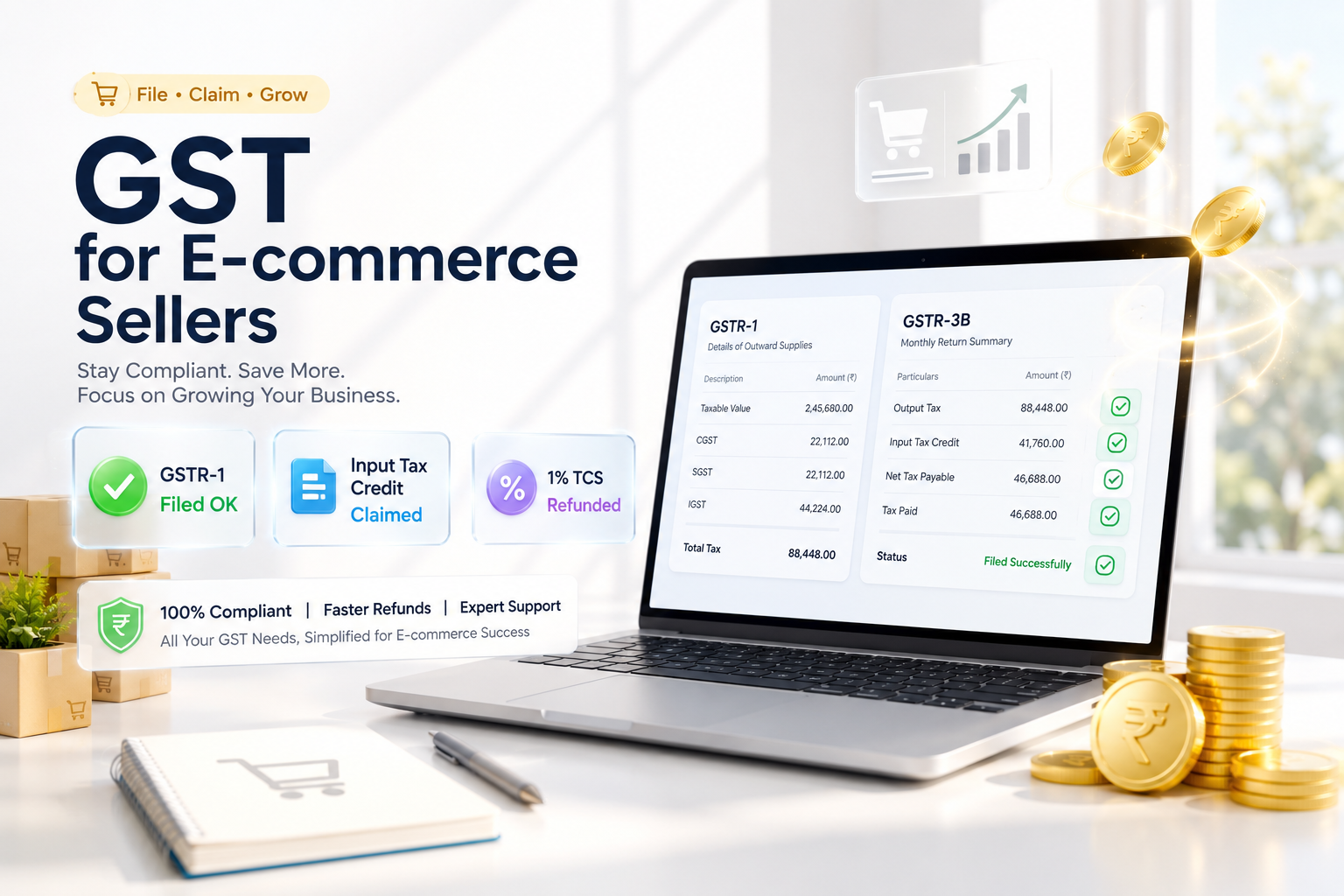
Dealing with taxes can be intimidating, especially when you are trying to focus on growing your online store. However, for e-commerce sellers in India, Goods and Services Tax (GST) is not just a tax; it is the entry ticket to the marketplace. Whether you are on Meesho, Flipkart, or Amazon, understanding GST is crucial for a smooth business journey.
In this guide, we will simplify GST for you—from registration to monthly filing—so you can stay compliant, save money on tax credits, and avoid marketplace penalties without the headache.
Is GST Mandatory for E-commerce Sellers?
This is the most common question among new online sellers, and the answer has a very important legal nuance under Indian tax laws:
- National / Inter-State Selling (Mandatory GST): If you want to sell your products across state borders (e.g., shipping a product from Gujarat to Maharashtra) via marketplaces like Meesho, Flipkart, or Amazon, GST registration is compulsory from Rupee 1 under Section 24(ix) of the CGST Act, regardless of your turnover.
- Intra-State Selling Exemption (No GST up to 40 Lakhs): Under the recent landmark GST Council notification, online sellers of goods with a turnover of up to Rs. 40 Lakhs (or Rs. 20 Lakhs in special category states) are exempted from mandatory GST registration, provided they only sell within their own home state (intra-state) and do not make any inter-state supply. Instead of a GSTIN, such unregistered sellers can generate an Enrollment Number on the GST portal to list their products, though they cannot ship orders outside their state.
🚨 Latest 2026 Update: GST 2.0 & E-Invoicing Rules
The GST framework for e-commerce in India has undergone major reforms. Make sure your business stays updated with these active 2026 regulations:
- GST 2.0 Rate Rationalization (New 4-Slab System): The previous 5-slab GST structure (0%, 5%, 12%, 18%, 28%) has been simplified into a 4-slab system: 0%, 5%, 18%, and 40%. The 12% GST slab is completely abolished. All products previously under the 12% category have been reclassified under either the 5% or 18% bracket. Ensure you audit your product HSN codes and update tax rates on Meesho, Flipkart, and Amazon panels to avoid compliance audits.
- New E-Invoicing Limit (Rs. 5 Crore): As of 2026, generating E-Invoices is mandatory for all e-commerce sellers whose aggregate annual business turnover exceeds Rs. 5 Crores. If you cross this threshold, you must generate invoices through the government Invoice Registration Portal (IRP).
1. Maximizing Input Tax Credit (ITC)
Many online sellers miss out on claiming their legitimate Input Tax Credit (ITC), which directly reduces their tax liability. When you sell online, you incur several business expenses that carry GST:
- Marketplace Commissions: Platforms like Meesho, Flipkart, and Amazon charge 18% GST on their commission rates and fixed fees.
- Logistics and Shipping: Couriers and marketplaces charge 18% GST on shipping charges.
- Packaging Materials: Buying boxes, bubble wraps, and thermal labels carries GST.
- Product Inventory: Purchasing raw materials or wholesale products from registered suppliers includes GST.
Always ensure your business GSTIN is updated on your suppliers' records and all seller panels so these charges are auto-reflected in your tax returns, saving you thousands of rupees monthly.
2. GSTR-1: The Outward Sales Return
GSTR-1 is where you report all your sales (outward supplies) to the government. This return must be filed by the 11th of every month (or quarterly if you are under the QRMP scheme). Marketplaces provide a "Tax Report" or "GST Report" every month that you can download and upload to the GST portal. This report splits sales into taxable values, Integrated GST (IGST) for inter-state sales, and SGST/CGST for intra-state sales.
3. GSTR-3B: The Payment Return
GSTR-3B is your monthly summary and payment return, filed by the 20th of every month. In GSTR-3B, your outward tax liability (calculated in GSTR-1) is offset against your eligible Input Tax Credit (ITC). The balance tax, if any, is paid to the government. Never miss this deadline as late fees and interest charges compile on a daily basis.
4. Understanding TCS (Tax Collected at Source)
When you sell on an e-commerce marketplace, the platform is legally required to collect 1% TCS (Tax Collected at Source) on your net taxable sales value and pay it to the government. This TCS acts as a advance tax. When you file your monthly returns, you can log into the GST portal, accept the TCS credit, and claim this 1% back directly into your cash ledger to pay off your tax liability.
5. How to Download GST Reports from Seller Panels
To file GSTR-1 and GSTR-3B, you need to collect monthly sales sheets. Here is how to retrieve them:
- Meesho: Go to Meesho Supplier Panel > Payments > Download GST Reports > Select Month.
- Flipkart: Go to Flipkart Seller Hub > Reports Center > Payments > Tax Reports > Select Month.
- Amazon: Go to Amazon Seller Central > Reports > Tax Document Library > Merchant Tax Reports > Monthly Sales Report.
Conclusion
GST compliance might seem complex, but once you set up a monthly routine, it becomes a simple part of your business operations. Staying compliant ensures your marketplace accounts remain healthy, protects you from legal notices, and allows you to claim every rupee of your input tax credits.
Frequently Asked Questions
No, if you only sell within your home state (intra-state) up to Rs. 40 Lakhs (goods) or Rs. 20 Lakhs (services) under the recent GST council exemption, by generating an Enrollment Number on the GST portal. However, if you sell nationally across state borders (inter-state), GST registration is compulsory from Rupee 1 under Section 24 of the CGST Act.
Yes! Meesho, Flipkart, and Amazon charge 18% GST on their referral commissions, shipping fees, fixed fees, and storage fees. This GST is listed on the monthly tax invoices they issue to you. You can claim this 100% as Input Tax Credit (ITC) to offset your tax liability.
GSTR-2B is an auto-generated, static Input Tax Credit (ITC) statement generated on the 14th of every month. It is crucial because you must match your purchase invoices and marketplace commission invoices against GSTR-2B before filing GSTR-3B to prevent claiming unmatched ITC.
🚀 Grow Your Seller Account with Our Tools
Process labels 10x faster, calculate absolute profit metrics and improve product listings instantly!