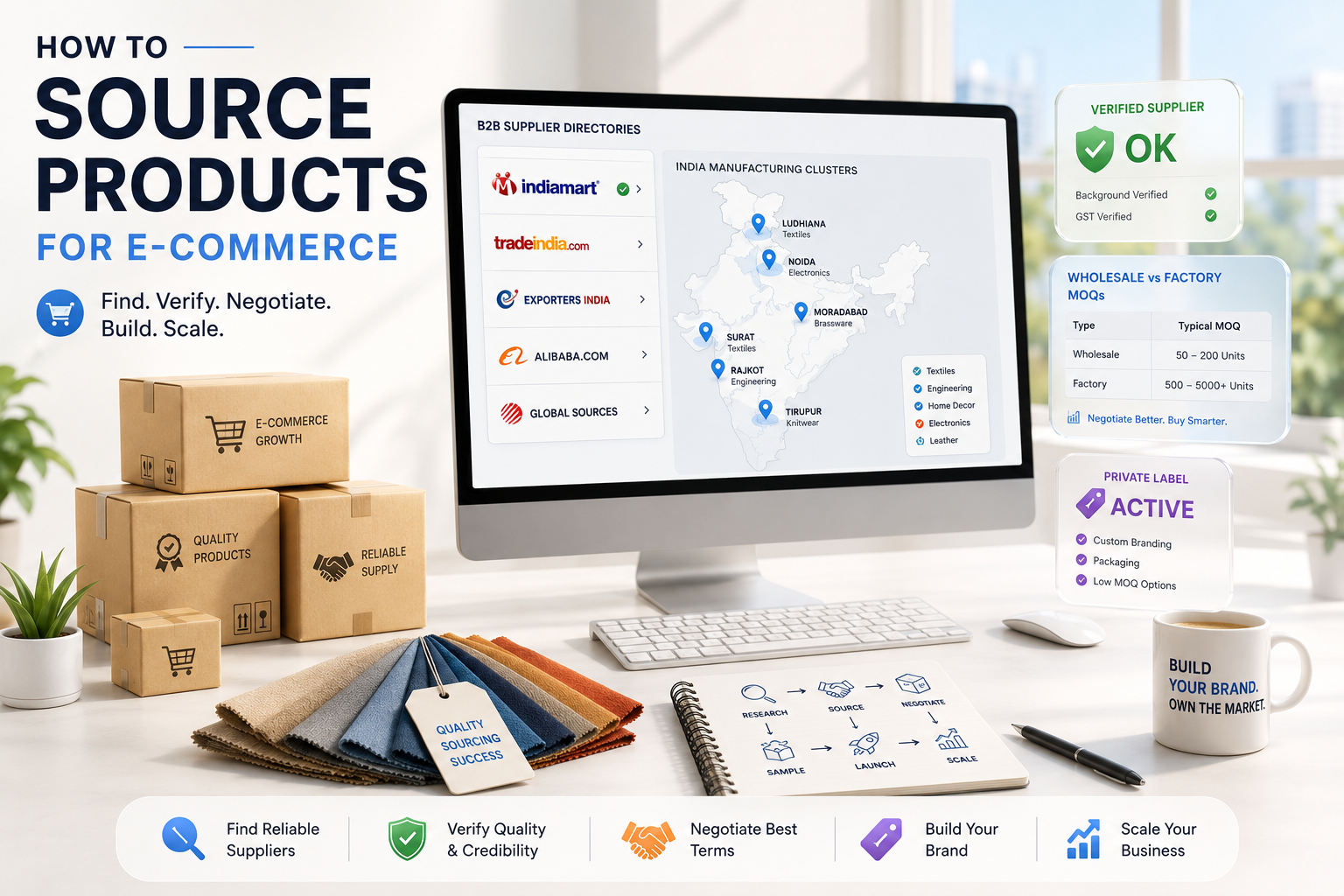
The success of your e-commerce business is decided the moment you buy your stock. As the old saying goes, "You make your profit when you buy, not when you sell." Finding the right supplier is the most challenging yet rewarding part of the seller journey.
Should you buy from a wholesaler in a local market or go directly to a manufacturer? In this guide, we will help you decide the best product sourcing strategy for your online store, reveal India's major manufacturing hubs, and show you how to source safely without getting scammed.
1. Sourcing from Wholesalers (Best for Starters)
Wholesalers are middlemen who purchase in massive quantities from manufacturers, store the stock in large warehouses, and sell in smaller lot sizes to retailers. Major wholesale hubs in India include Surat (textiles/sarees), Delhi - Sadar Bazar & Chandni Chowk (electronics, toys, cosmetics), and Mumbai - Crawford Market (fashions and home utilities).
- The Pros: Low Minimum Order Quantity (MOQs). You can buy as few as 10 to 20 pieces to test customer interest. There is lower initial capital risk, and you can visually inspect the goods immediately.
- The Cons: Lower profit margins because the wholesaler adds a middleman fee. Additionally, since anyone can buy from wholesalers, you have less control over product uniqueness, leading to high competition.
2. Sourcing Direct from Manufacturers (Best for Scaling)
Going direct means bypass all brokers and dealing directly with the factory floor. This is where you unlock the absolute "factory price" or bottom rate, leaving maximum room for profit margins.
- The Pros: Highest possible profit margins. Unlocks Private Labeling (selling under your own brand with custom logos). You can request custom adjustments, fabric quality improvements, and exclusive packaging.
- The Cons: High MOQs. Factories typically demand that you order at least 200, 500, or 1000 units upfront to configure their machines. Production and delivery lead times are also much longer.
3. Major Product Clusters and Sourcing Hubs in India
To maximize profits, you must know where your products are produced. Sourcing from a local cluster ensures the best pricing. Here is the Indian manufacturing map:
- Tirupur (Tamil Nadu): The knitwear capital of India, perfect for sourcing t-shirts, sportswear, and cotton innerwear.
- Surat (Gujarat): The synthetic textile capital, ideal for sarees, kurtis, dress materials, and ethnic wear.
- Jaipur (Rajasthan): World-renowned for ethnic block prints, cotton bedsheets, block-printed apparel, and artisanal handicraft items.
- Agra & Kanpur (Uttar Pradesh): Sourcing hubs for premium leather goods, safety shoes, boots, and casual footwear.
- Ludhiana (Punjab): The woolens and winter wear hub, ideal for sweaters, cardigans, and thermal innerwear.
4. Expert Negotiation Strategies for E-commerce Sellers
Negotiating with suppliers in Surat, Tirupur, or on online directories is not just about demanding the lowest price. It is about building a sustainable, long-term business relationship. Use these industry-standard negotiation tactics:
- Never Accept the First Quote: Wholesale prices always carry a 15-20% buffer margin. Politely show genuine interest in establishing a long-term contract and request a revised pricing schedule.
- Ask for a Tiered Volume Breakdown: Request quotes for different order quantities: 100 units, 500 units, and 1000 units. This signals to the manufacturer that you intend to scale and helps you plan your profit margins.
- Negotiate Sample Fee Adjustments: Serious B2B suppliers will charge a premium for product samples (often 2x to 3x the wholesale rate) to weed out casual retail shoppers. Always agree to pay this premium, but negotiate that the sample cost will be fully refunded or adjusted against your first bulk production invoice.
- Standard 30:70 Payment Terms: Never pay 100% upfront for custom manufacturing. The golden rule of B2B transactions in India is a 30% advance deposit to initiate production, and the remaining 70% balance paid only after a quality inspection (QC check) is completed and before shipment leaves the factory floor.
5. Online Sourcing Platforms (IndiaMART & Alibaba)
If travelling is not an option, online B2B directories are highly convenient. Platforms like IndiaMART, Alibaba, and Udaan host thousands of manufacturers. However, digital sourcing requires high caution. Follow these safety steps to protect your capital:
- Filter by Verified Status: Always filter suppliers with 'Verified', 'Trust Seal', or 'Gold Supplier' badges.
- Check GST Registration: Ask for a formal GST invoice. Genuine business owners will provide one instantly.
- Order Paid Samples: Never place a bulk order without testing a sample. Evaluate the finish, stitch, and build quality first.
- Avoid Personal Bank Accounts: Pay only to registered business bank accounts. Scammers always insist on immediate cash or personal UPI transfers.
Conclusion
Sourcing is an ongoing process. As your e-commerce business scales, your sourcing strategy will evolve. Start with low-capital wholesale lots, identify your winners, and then leverage direct factory partnerships to maximize your margins and build a defensible private label brand.
Frequently Asked Questions
For absolute beginners, local wholesalers are much better. They have a lower Minimum Order Quantity (MOQ), allowing you to buy 5-10 units of different items to test consumer demand without locking up heavy capital. Direct factories are ideal once you have a proven best-seller selling 20+ units daily.
Prioritize suppliers with a Verified or Trust Seal badge, verified GSTIN, and at least 3+ years of active history. Request a live video call from their warehouse floor, request paid samples first, and never pay advance money to personal bank accounts instead of registered business accounts.
No, wholesalers distribute generic, mass-produced products. For custom branding, custom logo tags, or tailored packaging (Private Labeling), you must partner directly with a manufacturer that provides OEM (Original Equipment Manufacturer) services.
🚀 Grow Your Seller Account with Our Tools
Process labels 10x faster, calculate absolute profit metrics and improve product listings instantly!